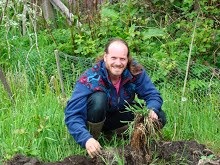
Up quite early as today I did have the Askham Bryan York Rotters gig so I was ready to go by just after 9, so went through Bishopthorpe Road, up Scarcroft road and out along Tadcaster Road and Moor Lane and over the new junction on the A1237 which I hadn't circumnavigated yet. I like the cycle facilities.
The Askham Bryan event (summer fair?) was on the big field but there were other things going on elsewhere such as a dog show and plant sales. I went to visit the chainsaw and log-wrangling area, and chatted with the various tree surgeons before it got busy and I had to get back to the Rotters stall.
The York Rotters mini-marquee had already been put up by Chris and Jean, and as I got into volunteer mode, Jo rolled up on her trusty bike. Jo is York's second most enthusiastic composter and we really worked the (small) crowds! My 'hook' was, when people walked past and looked at our cut-away dalek-bin with all sorts of compostable stuff in it, to ask them if they compost, and if the answer was affirmative, to ask them (excitedly!) to tell me about their compost heap! This isn't what a punter might expect, but it was in many cases irresistible and allowed a conversation to start. Invariably, people have questions about various aspects of composting... what can go on, cooked food, how to physically manage the heap, how to use the product... and more. I had a brilliant day, spoke to loads of people and met quite a few folks I knew, including Kit from around the corner, Martin from the Green Festival and several people who knew me as Fiddlesticks.
Jo went after lunch and was replaced by Claire, and we went on til 4.30pm. I helped her put the marquee down and start to pack up but needed to jump on my bike by 4.35. I cycled back through the village and then North via the ring road, which delivered me to Rawcliffe Bar 25 minutes later. I was due to meet Jonathan at 5.15 at Zippos Circus, to meet Martin Burton the Founder and Director, to be given a tour and see the show.
This came from the fact that there was an article in the paper about animal rights protesters removing publicity about Zippos, which has horses and budgerigars, including going into shops and saying they were from Zippos, and saying they had been forced to cancel and taking the posters and fliers away. I had responded with a letter saying I had some sympathy with them, and Martin Burton had written in the next day inviting me to come and see for myself (see clickable links in 3 June post).
Martin was waiting in the ticket office and when Jonathan and I turned up, took us for a coffee and a chat about how he had arrived at being the Director of Zippos Circus for the past 35 years. He had started out doing teacher training but had done some busking as a clown and escapologist, and this he felt was more his kind of thing. He told his parents that as there were not many jobs for middle school drama teachers, he'd do a few years as a performer and then settle down into teaching. He declared that he had been a disappointment to his parents as he'd never gone back into teaching and his mother still occasionally joked to him about getting a proper job... He'd done a load of touring with his clown troupe but the problems with different venues meant he needed a venue which would be the same each time, so he got a big top.. well, his first was a large frame tent, but at least the performers could get used to the venue!
He either helped organise or was responsible for the London International Festival of Circus back in the 1980s, where there was his 'traditional' circus, with clowns and jugglers, horses and, I think ducks, alongside a new or 'alternative' circus with no animals and things like people climbing ropes naked, and initially there was some mutual animosity and mistrust. But this went as the respect for the different approaches grew.
He has always had a lot of respect for the horses and other animals in his circus, and disapproves of wild animals being kept and used. Both the horses and budgies have been living alongside people for countless generations, and they are trained using positive reinforcement, never punishment. The horse trainer will sometimes go and just observe the horses in the paddock for hours at a time, and as soon as one does something he would like it to do in the ring, he gives it an edible treat of 'pony nuts' which are made of grain and horses love them. If the animal does this again, he gives it another. The whip which is used in the ring is not used for actually whipping the horse, it is a visual signal. I watched this closely during the show, and not once did the whip actually touch any horse. There is more info about the horses on this part of Zippos website (just click on 'animal welfare') .
Martin took us for a walk around the circus, showing us his chip-fat powered vehicles (all of them and the generators are powered by used cooking oil) and the low energy lightbulbs, making his chip-fat bill not quite as high! The loose-box stables, designed by Born Free had the 4 Palomino Arab-cross stallions in the front of the big top, where members of the public could see them, and the two grooms live very close to them so if there's any distress or problem, they would hear. One of the grooms came to the door of his caravan as we walked round, so they are listening all the time. The place where they pitch the big top must always have a paddock area, as the horses spend quite a bit of time outside, running free. Their travelling horse box has a ramp at the rear and at the side so that if there is a 'rear shunt' the horses can be taken out of the side.
We looked into the budgerigar caravan and heard a description of how they line up to get into their cage when the show is about to start, which I found hard to believe until I actually saw the show.
Most of the show is human, not animals. There is one part where the tiny Fallabella horse gallops round following one of the huge Palominos, and a part where the Palominos go round the ring and turn circles, and one of them rears up on it's hind legs, which is part of it's mating behaviour (which is why they use stallions). The budgie act was good, I really enjoyed that as I'd never seen performing birds. But for me, the best bits were the high wire, the aerial stuff, trapeze, rope work, jugglers and diabolo player, the Marinhos 'Wheel of Death' (brilliant!) and dancers. I'm not a big fan of clowns but enjoyed their many skills and their timing.
Martin chatted to us during the interval (and said hello to Jim Semlyen, who was there with his children and mother) and afterwards too. He took great pleasure in telling us as much as he could, and answering any questions, and I was left in no doubt that the animals and people are cared for, loved, respected and certainly not mis-treated. I came away feeling much more educated about real circuses, and the situation they find themselves in with regards to the tiny but vocal minority of animal rights protesters. I hope that these protesters concentrate on the few circuses left with wild animals, and leave Zippos alone. And if they do want to really see how Zippos treats their animals, I'm sure that Martin would show them around just like he did for me.
For a taste of what Zippos Circus is like, watch this 3 minute slideshow. Or go and see it yourself. And say hello to Martin from me!
I said my goodbyes to Jonathan who was there by automobile and I cycled home, getting in about 9pm. All was well at home, with a friend visiting and getting ready for a sleepover.
Showing posts with label Askham Bryan. Show all posts
Showing posts with label Askham Bryan. Show all posts
Saturday, 6 June 2009


Wednesday, 14 March 2007
Wednesday 14th March 07
Woke feeling just a little sad at last night's email from the Yorkshire Post, but glad I'd responded politely as I like to keep options open and not burn boats.
When I was offered my column I contacted my friend Kate who writes a column for the York Press and asked her if she'd give me some tips and advice. In return, she asked me to help her with her compost bin which she's had for just over a year, and needs some management. Of course I was happy to help with her composter, and even if she now no longer needs to give advice to this non-columnist. I dug out the bottom of the dalek, the material was mostly well rotted and will need a short while maturing before it is used in her garden. The plastic and unrotted bits were taken out and put in their respective places (dustbin and top of compost pile) and the semi mature stuff put in a polybag for revisiting soon, when I'll Rotaseive it, a hand-powered mechanical riddle which separates small particles from larger sticks, etc.
I didn't have time to sit and have a coffee or a chat about the gutter press, as I was due at Askham Bryan Agricultural College for a short course about trees, evaluating the amenity value of trees and evaluating the different calorific value and burning quality of different types of wood. This latter issue is close to my heart, as all these blogs are written in front of my 4.5kw Clearview smokefree woodstove, which heats the front room and the bedroom above. So I learnt less from the second worksshop, apart from some numerical stuff such as how many BTUs (British Thermal Units) are in different species of tree's wood, fresh cut, air dried and kiln dried. The amenity value evaluation was completely new to me, a rather complicated and not very precise set of calculations called the Helliwell Method. However we were novices and if done by someone who knew what they were doing, it is a reasonable way to calculate an objective value of a tree from factors which are mostly subjective. Different people value trees for different things... an artist will see the shape and form, a biologist will see the ecological value, a timber merchant or woodburner will see something else. The method also enables a value in pounds sterling to be made, for compensation claims perhaps. We went into the grounds and attempted some amenity evaluations, then retired to the classroom to ccompare notes and discuss. Very interesting.
Then bombed back into York and filled up the cycle trailer with compostables and got home in time to meet up with a zoologist/entomologist from the Yorkshire Museum, who had been very interested in my find of some Minor Stag Beetles in a partially rotten log which I'd split. Often I put obviously rotten logs under a hedge in the garden so that beasties get a chance to live and breed, but this log didn't appear that bad, as it was mostly sound and would be good for burning. However when it split, a load of juicy woodboring beetle larvae fell out, plus a couple of adults, easily identifiable and in my book, rare and not found north of Nottingham. Pip the bug lady told me that they had actually been found as far north as Edinburgh and were found in the York area. Still a nice record for them, and Pip enjoyed the stroll down the garden and was pleased to see our Goldcrests which love the trees above my fruit-fly infested composters, and feast on the little blighters. How nice it feels to take materials which would otherwise be landfilled and lost for ever, and turn them into Britain's smallest bird plus a material which traps carbon into the soil and helps us grow delicious squashes and sweetcorn.
Our garden also has good populations of blackbirds which enjoy turning over mulches and flicking them around, also pecking at unsold apples which I often deliberately throw onto the lawn for them, and robins which love it when I move bags of compost around and reveal worms and other invertebrates which they hop down and eat. When working in the garden I always have their company. I'm not good at identifying other birds, but Gill has identified Song Thrush, Mistle Thrush, House Sparrows and Dunnocks, Blue/Great/Long Tailed/Coal Tits, Chaffinch, Greenfinch, Goldfinch, Siskin, Starlings, Collared Dove and Wood Pigeons, Magpies, Wren, Treecreeper, Redwing, Blackcap Warbler, Fieldfare, a Kestrel (swooping towards the bird table) and Mallard Ducks visiting next door's pond.
It is very satisfying to have so much life enjoying our land, of which we are temporary stewards. The garden looks messy to people but is a haven for animals, plenty of nesting areas and ecological niches.
When I was offered my column I contacted my friend Kate who writes a column for the York Press and asked her if she'd give me some tips and advice. In return, she asked me to help her with her compost bin which she's had for just over a year, and needs some management. Of course I was happy to help with her composter, and even if she now no longer needs to give advice to this non-columnist. I dug out the bottom of the dalek, the material was mostly well rotted and will need a short while maturing before it is used in her garden. The plastic and unrotted bits were taken out and put in their respective places (dustbin and top of compost pile) and the semi mature stuff put in a polybag for revisiting soon, when I'll Rotaseive it, a hand-powered mechanical riddle which separates small particles from larger sticks, etc.
I didn't have time to sit and have a coffee or a chat about the gutter press, as I was due at Askham Bryan Agricultural College for a short course about trees, evaluating the amenity value of trees and evaluating the different calorific value and burning quality of different types of wood. This latter issue is close to my heart, as all these blogs are written in front of my 4.5kw Clearview smokefree woodstove, which heats the front room and the bedroom above. So I learnt less from the second worksshop, apart from some numerical stuff such as how many BTUs (British Thermal Units) are in different species of tree's wood, fresh cut, air dried and kiln dried. The amenity value evaluation was completely new to me, a rather complicated and not very precise set of calculations called the Helliwell Method. However we were novices and if done by someone who knew what they were doing, it is a reasonable way to calculate an objective value of a tree from factors which are mostly subjective. Different people value trees for different things... an artist will see the shape and form, a biologist will see the ecological value, a timber merchant or woodburner will see something else. The method also enables a value in pounds sterling to be made, for compensation claims perhaps. We went into the grounds and attempted some amenity evaluations, then retired to the classroom to ccompare notes and discuss. Very interesting.
Then bombed back into York and filled up the cycle trailer with compostables and got home in time to meet up with a zoologist/entomologist from the Yorkshire Museum, who had been very interested in my find of some Minor Stag Beetles in a partially rotten log which I'd split. Often I put obviously rotten logs under a hedge in the garden so that beasties get a chance to live and breed, but this log didn't appear that bad, as it was mostly sound and would be good for burning. However when it split, a load of juicy woodboring beetle larvae fell out, plus a couple of adults, easily identifiable and in my book, rare and not found north of Nottingham. Pip the bug lady told me that they had actually been found as far north as Edinburgh and were found in the York area. Still a nice record for them, and Pip enjoyed the stroll down the garden and was pleased to see our Goldcrests which love the trees above my fruit-fly infested composters, and feast on the little blighters. How nice it feels to take materials which would otherwise be landfilled and lost for ever, and turn them into Britain's smallest bird plus a material which traps carbon into the soil and helps us grow delicious squashes and sweetcorn.
Our garden also has good populations of blackbirds which enjoy turning over mulches and flicking them around, also pecking at unsold apples which I often deliberately throw onto the lawn for them, and robins which love it when I move bags of compost around and reveal worms and other invertebrates which they hop down and eat. When working in the garden I always have their company. I'm not good at identifying other birds, but Gill has identified Song Thrush, Mistle Thrush, House Sparrows and Dunnocks, Blue/Great/Long Tailed/Coal Tits, Chaffinch, Greenfinch, Goldfinch, Siskin, Starlings, Collared Dove and Wood Pigeons, Magpies, Wren, Treecreeper, Redwing, Blackcap Warbler, Fieldfare, a Kestrel (swooping towards the bird table) and Mallard Ducks visiting next door's pond.
It is very satisfying to have so much life enjoying our land, of which we are temporary stewards. The garden looks messy to people but is a haven for animals, plenty of nesting areas and ecological niches.
Subscribe to:
Posts (Atom)